Level Designer

I wanted to challenge myself to take the feedback received from GP2 for this level and redesign it from scratch and practice the process of iteration and feedback to create a more cohesive and engaging experience.
Constraints
Semi-linear level, single-player PvE, 5-8 minute playtime, 3D Action Adventure, UE5
Introduction
For this project, I pushed myself to redesign
the Village Ruins Level I created from
Game Project 2 "Shattered Veil" at Futuregames.
For this level, I wanted to focus on...
-
Designing Puzzles to center around the core mechanic
-
Balance the pacing between puzzles and combat
-
Create a more consistent and cohesive level in environment, narrative, and puzzles.
Blockout: Village Ruins
Genre: 3D Puzzle Action Adventure
Type: Blockout
Engine: Unreal Engine 5
Tools: Level Design Kit Asset Pack
Development Timeline: 8 Weeks
Playtests #: 4
Team: Solo Project
Role: Level Designer
Level Overview
Summary
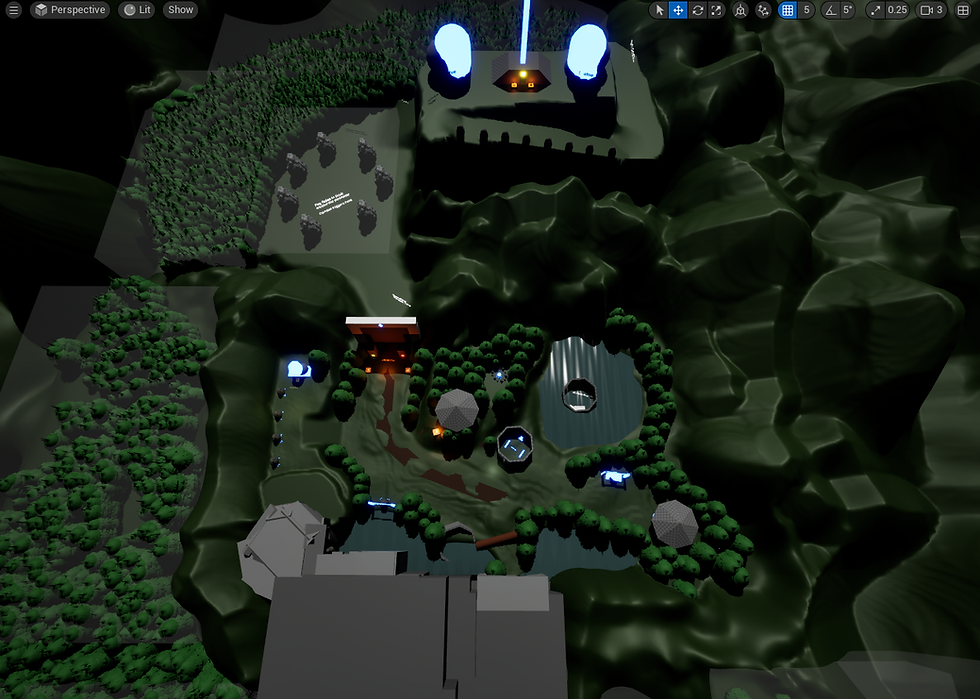
The forest has been corrupted by the Fae of the Otherworld and it is up to the player - an acolyte of a religious order against the Fae - to find the Ritual Dagger, an ancient blade that contains voices of heroes from the past.
The player must find the relics from this land's history to perform the Rite of Cleansing to rid the corruption and save the land.
.png)
Core Mechanic: Playing with Perspective
-
Designed around the core mechanic: the Seeing Stone, a mystical item that reveals echoes of the past.
-
Used contrasting visual language to differentiate between past and present timelines for intuitive gameplay.
-
Layered level layout to encourage exploration, re-evaluation, and revisiting areas with new insight from the past.

World Building: Uncovering the Past
-
Created environmental storytelling moments where players glimpse history to uncover hidden paths and lore.
-
Revealed the history of a forgotten religious village through layered environmental clues and ghostly echoes.
-
Encouraged curiosity-driven exploration by letting players uncover narrative threads at their own pace.

Puzzle Solving: Discovering Solutions
-
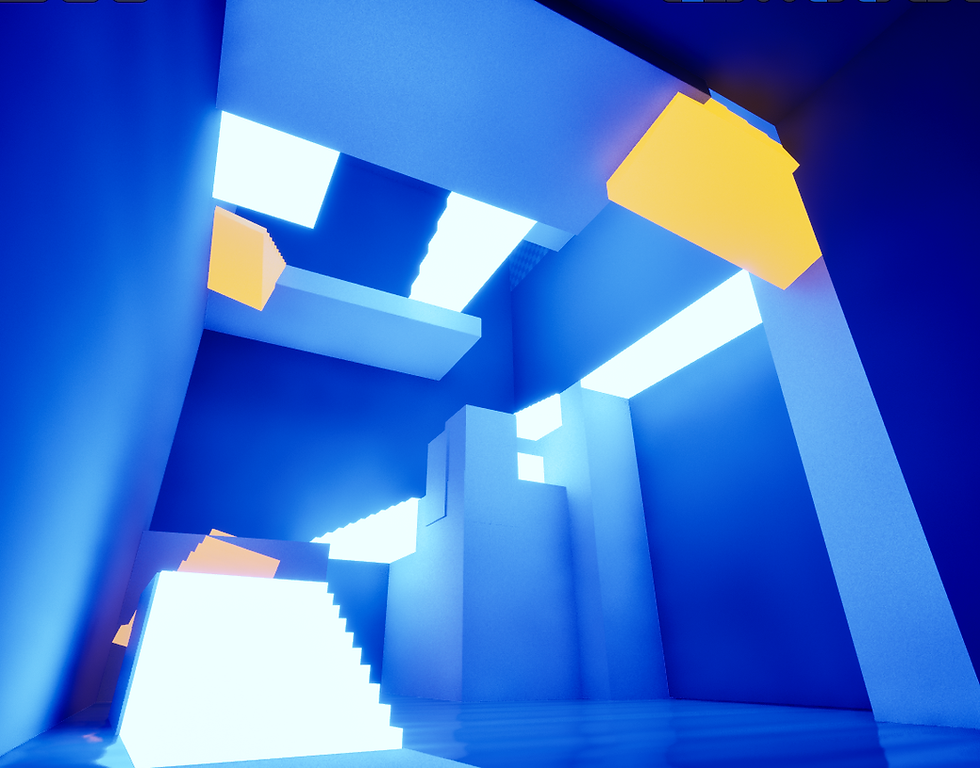
Integrated puzzle sequences requiring players to observe the past and present to progress.
-
Designed puzzles to give the player different information between the past and present to discover the solution.
-
Incorporated narrative within puzzles by utilizing environmental storytelling between the past and the present.
Level Breakdown

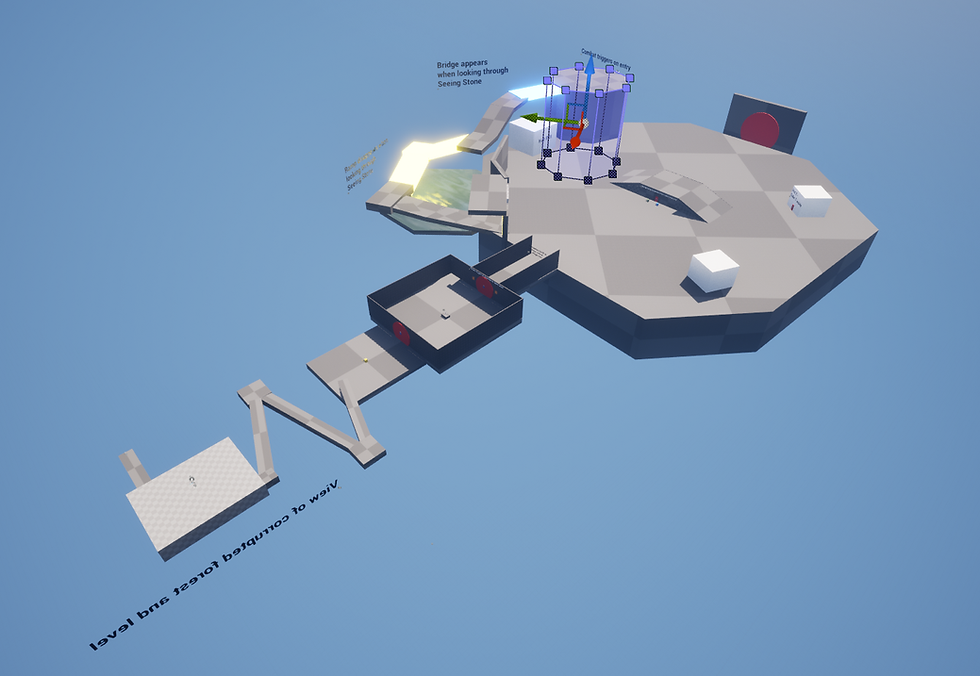


1. Traversal: The Overlook
The player begins in a clearing facing a blocked gate, which can only be passed through by activating the Seeing Stone. A short on-screen prompt introduces this mechanic, teaching the player its purpose and use.
Beyond the gate, the player reaches a vantage point overlooking the environment, where a distant landmark serves as a clear visual objective, guiding exploration. From there, the player descends the hill, navigating through obstacles that require the Seeing Stone to overcome. Along the way, subtle environmental storytelling elements contrast the past and future, reinforcing the world’s tone and narrative context.

2. Puzzle Introduction: Village Entrance
At the village entrance, the player is introduced to one of the core puzzle mechanics — the keystone and pedestal system. Ahead lies a blocked cave entrance and a keystone on the ground, accompanied by a prompt indicating that it can be picked up.
In front of the cave are two pedestals: one already holding a keystone, and another that is invisible to the naked eye but revealed through the Seeing Stone. To progress, the player must activate the Seeing Stone and place the keystone onto the hidden pedestal, learning how the two mechanics interact.

3. Traversal/Puzzle: The Cavern
Upon entering the cave, the player glimpses an opening on the far side leading back into the village. However, as they approach, the exit collapses, and the ground gives way, sending the player tumbling into a lower cavern.
This section focuses on traversal and spatial puzzle-solving. The player must alternate between normal vision and the Seeing Stone to navigate upward, as platforms appear or disappear depending on which state is active. The platforms also convey subtle environmental storytelling — some appear newly built, representing the past when looking through the Seeing Stone, while others are broken and decayed, symbolizing the present when looking with normal vision.

4. Combat: Cave Exit
At the top of the cavern, the player makes their way toward the cave exit. Along the path, a hole in the cave wall serves as another vantage point for the player's primary objective in the next area: Keystone Gate, subtly guiding the player forward.
Upon reaching the exit, the way out is blocked by rock, and at the center of the chamber rests a dagger embedded in stone. When the player retrieves the dagger, a voice-line triggers, introducing the narrative and the voice tied to the weapon. Moments later, enemies appear, and the player is introduced to combat. Once the battle concludes, the exit unseals, allowing the player to continue toward their next objective.

5. The Village
Upon entering the village, ahead of the player is a large statue with a keystone resting at its base. This keystone is the first of two required to unlock the Keystone Gate previously revealed from the cave exit.
After placing the keystone, the player is encouraged to explore the village at their own pace. This section offers a moment of calm and environmental storytelling, allowing players to experience the village in both the past and present through the Seeing Stone. They can discover areas such as a once lively hut, now decrepit and empty, and an abandoned ritual clearing that hints at the world’s lost history.
Among the three huts, the first is locked, the second serves a narrative purpose to emphasize the contrast between timelines, and the third leads the player to the next area: the underground tunnel.

6. Combat/Puzzle: The Underground Tunnel

Inside the underground tunnel, the section is divided into two parts: the first emphasizes narrative and environmental storytelling, while the second focuses on traversal and puzzle-solving.
In the first half, players can use the Seeing Stone to reveal cave paintings along the walls. Upon reaching an open underground clearing, they encounter remnants of a cultic ritual site, and combat triggers that the player must resolve before continuing.
Beyond the clearing, the player discovers a large statue surrounded by platforms. Here, they must once again alternate between normal vision and the Seeing Stone to navigate upward, using the platforms to ascend out of the tunnel. The path ultimately leads back inside the first locked hut seen earlier in the village, where the player finds both the key to exit and the second keystone required to open the Keystone Gate.
7. Combat: The Keystone Gate
Upon leaving the hut, the player can now unlock the Keystone Gate to progress further. Beyond the gate lies an axial stone circle, serving as the stage for the third combat encounter.
As the player enters the circle, the encounter is triggered. Although not implemented in this blockout, the surrounding area is intended to fill with dense fog, enclosing the space and preventing the player from advancing or retreating until all enemies are defeated.
Once the enemies are defeated, the player can continue and climb up to the final part of the level - The Burial Mound.

8. Navigation: The Burial Mound

Climbing the mountain path, the player reaches their final destination — the Burial Mound, where the level ends. Inside the mound, the player obtains the Relic, marking the completion of the level and the fulfilment of their objective.
Reimagining the Level
My goal for this project was to rebuild my level from Shattered Veil and start from scratch. I wanted to revisit the core inspirations and references to redefine the tone and direction.
I knew I wanted to focus on creating a more balanced and engaging gameplay experience with the core mechanic of the Seeing Stone, enhance the level’s tone and mood with environmental storytelling, and finally a good balance between puzzles and combat.
Key Influences I took from during the research stage of this project:
Alan Wake’s dark forest environment and rich atmosphere
Hellblade: Senua’s Sacrifice, Emotional Storytelling and immersive tension as well as its balance between puzzles and combat
Celtic Ritual and Mythology, for inspiration for the type of items the environmental storytelling may entail.
Process Breakdown
Pre-Production
Research Miro Board

Level Design Document

Level Design Document
When I started to set up my level design document, I wanted to keep it simple and focus on my design goals first and foremost. I wanted to identify where I went wrong with the previous level and focus on setting my goals to correct where I failed:
-
Players should feel a rise in tension as they explore.
-
Puzzles should focus around the primary mechanic of using the Seeing Stone.
-
The player should feel the experience of being in an archeologist’s shoes and uncover a past that once was.
Once the goals were set, I defined these areas within the LDD:
-
Level Objectives
-
Narrative & Setting
-
Key Points of Interest
-
Gameplay Mechanics
-
Level Beats
-
Village Layout and Structure
2D Map
When creating the 2D map, I initially drew too much influence from my previous level, Shattered Veil. While the layout felt familiar, this version placed a stronger emphasis on puzzles built around the Seeing Stone mechanic.
Based on player feedback from Shattered Veil, I also explored incorporating the dagger throw mechanic into non-combat puzzles, adding targets that unlock doors when hit.
Feedback on the 2D map was positive regarding overall structure but suggested breaking up the village layout with clearer routes and adding detail to better communicate puzzle flow. A map legend was also recommended for readability.
In a later iteration, I redesigned and remade the 2D map to address this feedback and refine the level’s spatial structure — shown in subsequent iterations.
2D Map


Blockout and Iterations
Initial Blockout
When creating the first blockout based on the 2D map, I focused on four key goals:
-
Structuring the core layout and puzzles: Implemented the basic floor plan to visualize gameplay flow before adding mechanics.
-
Color-coding for the Seeing Stone: Used blue and orange to differentiate visible and invisible objects tied to the mechanic.
-
Introducing player mechanics: Began with intentionally simple puzzles to teach systems early, planning to iterate based on feedback.
-
Clarifying player objectives: Placed the Burial Mound at the map’s center to make the final goal clear from the start.
However, during the blockout, several issues became clear:
-
The 2D design didn’t translate well into guiding routes for the player.
-
The village layout lacked verticality and felt flat.
-
While the objective was visible, the exit behind the Burial Mound was unclear and poorly signposted.
-
The combat introduction in the cave felt abrupt and disconnected from the pacing of the level.

First Iteration
For the first iteration, I decided to change direction. The initial design overemphasized puzzle mechanics - such as the keystone and pedestal - while underutilizing the core mechanic of the Seeing Stone which didn't come into play until the cave section. I also decided to remove the dagger-throw puzzle mechanic and refocus the level around the Seeing Stone as the central feature.
Incorporated this by adding more puzzles that use the Seeing Stone ability within the huts. Here, you'll see the first iteration of the underground tunnel, with the player traversing underneath one of the huts to find the key that unlocks the hut with a keystone inside.
The introduction was restructured to teach the Seeing Stone earlier and connect it more naturally to traversal and puzzle flow. In addition, adjusted the combat encounter, moving it to when the player acquires the dagger to create a stronger, story-driven introduction.
I expanded the village layout to provide clearer navigation and temporarily removed the burial mound - I wanted to focus on the main area in the meantime but planned to add the burial mound back later on to make it a landmark objective. This is where I added the keystone gate that would eventually lead up to the Burial Mound, and I placed it so the Keystone Gate could be seen from the player start in an attempt to hint to the player where they need to go.
I relocated the cave to the right side of the map with the intent to have the cave entrance a bit closer to the player when they enter the village. I also restructured the traversal puzzle within the cave to add a bit more use to the Seeing Stone.
Feedback Received
I playtested with two other level designers and this was their feedback for the first iteration:
-
I tried to structure the level to give the player the freedom to explore and approach puzzles in any order, but it backfired and caused confusion and hesitancy in the player
-
At this stage, looking through the Seeing Stone gave no player feedback on whether it was toggled on or off - and this commonly made both players to forget that they had the Seeing Stone ability.
-
However, when they solved a puzzle, both players had a fun “ah HA!” moment
-
-
Platforming was hard with the basic character controller - so traversal puzzles were frustratingly difficult - players also felt that the level was too large to have no sprint function.
-
Both players didn’t notice the Keystone Gate from the player's starting position, leaving them lost on where to go and what they needed to do.
-
One player really liked the sprinkled narrative elements in the Underground Tunnel with narrative text on the walls
-
One player commented that the simplicity of the puzzles are great and gives more room to become more complex - they also really liked the text within the level giving more context to the level sections
-
Level felt very flat
-
Both players enjoyed the Seeing Stone mechanic and the puzzles after they solved them.
Before
After


Before


Second Iteration
For this pass, I added more terrain and environmental assets to help establish the setting. I created the end area and implemented the Burial Mound, featuring a combat encounter and large vista point for the player to see from the starting area. Here I really tried to highlight the burial mound and make it obvious to the player from the start, so the player can see their objective immediately.
I also elevated the starter area for a stronger first impression of the Burial Mound vista while also expanding the path down to the village entrance to improve navigation and remove falling hazards.
I introduced verticality within the main village area and added a lake to try to break up the large open space while also defining sub-areas; but it still needed a lot of work and was only introduced on the right side of the map. I also added new landmarks and points of interests to guide exploration.
I expanded the Underground Tunnel to create the opened up cave section and added additional environmental storytelling elements while also implementing the vertical traversal puzzle to improve pacing and use of the Seeing Stone mechanic.
After


Feedback Received
For this iteration, I got feedback from level design mentor Jordan McMorris:
-
The landscape and elevation were a nice touch
-
Village Terrain could use more variation (e.g., some huts placed on uneven ground for a natural flow)
-
I should add some traversal elements within the village for a nice touch (e.g., fallen logs, uneven ground, etc)
-
The end-goal vista show is great and shows establishment of the primary objective
-
However, it could be improved by framing it better by raising nearby hills and aligning tree lines
-
-
The Keystone Gate puzzle effectively re-establishes the objective
-
The expanded jumping puzzle in the Underground Tunnel was engaging, but it felt cramped; he recommended expanding it horizontally to give the player more room to jump to reduce frustration from falls.
-
The first two chambers with the first puzzle and combat feels repetitive - could be merged into one more cohesive situational puzzle.
-
I have a solution ordering problem for the keystones to the keystone gate where the player is encountering the solution (the keystones) to a problem before discovering the actual problem itself (the keystone gate)
Suggestions Jordan gave:
-
I should have the player traverse the cave first and focus on the Keystone gate and red keystone as a central objective
-
If I place the locked house along the main path, it will naturally signal that a key must be found later
-
I should consider a “reveal through perspective” moment on one of the huts leading to the tunnel, similar to earlier visual reveals in the level.
2D Map - Revamped
With Jordan’s feedback, I decided to return to the drawing board and re-evaluate the level as it stands. I made a new 2D map - one that is more detailed after taking feedback from the previous 2D map - and focused on restructuring the order of how the player encounters problems, add more POIs to serve as guidance and/or worldbuilding, and repositioned the layout to give it a more natural feel.
Third Iteration
With the third iteration, I moved the cave area to be right after the Village Entrance - removing the dagger introduction arena and integrating it inside the cave after the traversal puzzle. I did this to make the player more familiar and comfortable with using the Seeing Stone to solve puzzles, which also led me to expand the traversal puzzle within the cave - making it larger and introducing it a lot sooner than before. I also added a scripted event here where the player falls down into the bottom of the cave and has to go through the traversal puzzle to get back up in an attempt to subvert player expectations and force them to get "lost". At the end of the cave is where the player will find the dagger and be introduced to combat, before the cave opens up into the village main area and reveals the red keystone for the Keystone Gate.
I tried to break up the main village area to provide more guidance and elevation to keep the level from feeling too flat. I repositioned the locked hut to be the first thing the player sees when they enter the main area, implying they can access it later. I made sure the Keystone Gate was positioned next to the locked hut so the player can easily identify their next objective. As for the entrance into the underground tunnel, I pushed it back deeper into the village while adding pathing leading toward it so the player has room to explore but is still guided toward their next steps. I completely overhauled the tunnel to expand upon the jumping puzzle at the end and to make it feel more secretive and ritualistic to reflect the cult-like nature of the village. Voice line cues and hidden details such as cave paintings (visible through the Seeing Stone) remained to guide the player’s progression. The open area within the tunnel now includes a combat encounter to increase tension as the player discovers this hidden ritual site; I wanted combat to be more prevalent within the level while keeping a steady pacing with puzzles.
When the player resolves combat and gets through the jumping puzzle, they now end up inside the locked hut to find the second keystone and the key. I made it this way to reduce backtracking and to have them emerge right outside the keystone gate to continue forward. After the gate, the rest remains the same with the final combat encounter and the walk up to the Burial Mound to retrieve the relic and finish the level.
Feedback Received
During playtesting, here are the key takeaways I received feedback from three other level designers:
-
Players frequently forgot to use the Seeing Stone at the start of the level with the first puzzle - they needed clearer prompts or reminders
-
Players enjoyed the vista shots, exploration, and Seeing Stone worldbuilding, but the pacing and guidance with them needed refinement
-
While the current worldbuilding was good, players wished there were more elements to it with the Seeing Stone as it encouraged them to explore a lot more and uncover secrets that weren’t there.
-
One player noted that the Seeing Stone only gave the player “more” information, but not “different” information, saying that there was little to no reason to not toggle the Seeing Stone unless it was for puzzles
-
Another player praised the Seeing Stone mechanic for encouraging spatial awareness. It encouraged the player a lot more to look around and look up to discover new things.
Before


After


Before
Final Iteration
For my final iteration, I focused on fixing the lighting, adding more worldbuilding through environmental storytelling, and refining puzzles for better guidance and exploration.
I changed the setting to night-time and removed Lumen for better performance and smoother transitions between dark and light areas. I also added lighting to the Keystone Gate to better highlight it when seen from the vista shot.
Based on player feedback, I added more environmental storytelling and points of interest. Since the Seeing Stone reveals secrets, players wanted more hidden elements to discover, often backtracking to explore. This led me to focus on giving players different information through the Seeing Stone, not just more.
Here, I began emphasizing the divide between the “past” and “present.” Players can now find remnants of where people once lived or worshipped—destroyed huts, ritual sites, and skulls—and, through the Seeing Stone, see these places as they once were. This encourages players to view the world through multiple perspectives and engage more deeply with the environment.
I also moved the first keystone’s location to fix the “solution-ordering” issue, ensuring players encounter the red keystone after seeing the Keystone Gate. Finally, I adjusted the jumping puzzle in the Underground Tunnel to make platforming smoother and more forgiving.


After
Reflection
Overall, for this project, I am pretty proud of what I have created. This level is far from perfect and still has many issues, but is a far improvement from the original level in Shattered Veil. I learned a lot from this project, like solution-ordering problems, how to better guide the player, and understanding the difference between just giving the player more information and giving the player different information.
I still made plenty of mistakes, for example, I still technically have a solution-ordering problem despite trying to fix it two times. The first keystone was only pushed back a bit farther but technically still shows before the player actually encounters the keystone gate. While the vista shot from the cave helps show the player their next objective, the player should still have the opportunity to walk up to the gate first and see it and not have the backtrack for the keystone.
Guidance is a lot better but still could use some work, and elevation could be utilized a bit better. To me, some of the elevation feels like it's there just to add more verticality than a natural feel of an environment with uneven ground. I would have liked to break up that space a little more and adjust the layout to better organize the puzzle order.
The biggest thing I have learned from this project though, is how to document my work and keep track of player feedback and iterations for every step of the way. At the end of each week I made sure to keep track of each pass I made and write the changes I made and the why of it, while also recording feedback to take into consideration for the next iteration. This helped me tremendously to not just keep track of my own work, but to also better analyze next steps and what I should do for the next pass.
Going forward from this, I learned a lot of design techniques to take into consideration for future projects and how to better document my work so I can record my progress better and understand where I went right and where I went wrong.