Level Designer

During pre-production, I worked side by side with the narrative team, understanding the world we were building and aligning level beats with narrative beats within our short timeframe. I also coordinated with system designers as we planned mechanics and determined what types of puzzles the player would navigate. In production, I worked with the art team to plan assets and bring the blockout to life.
However, we faced several challenges as a team, along with issues I encountered individually, such as scope creep, limited budget for special assets, and not adhering as closely to our pre-production plan as we should have. To read more about the problems encountered, click here.
Introduction
"The Last Branch" is a vertical slice of a narrative third-person adventure game that takes place in a ruined temple taken over by corruption, with the player character waking up as the last hope to cleanse the corruption.
Worked on a team of 15 people, collaborating closely with narrative designers, system designers, and the art team. I was the only level designer for this project.
The Last Branch
Genre: 3D Narrative Adventure
Type: Finished Product
Engine: Unreal Engine 5.5
Tools: Perforce
Development Timeline: 7 Weeks
Team: 15 People
Role: Level Designer

Level Overview
The Last Branch is a beautiful adventure game, where you play as a child of the Godtree, the last hope for life. Explore an ancient abandoned temple, and meet the many lost spirits, lingering in its halls. Repel the infestation of Rot and escape from the temple to restore life to the world!
Summary
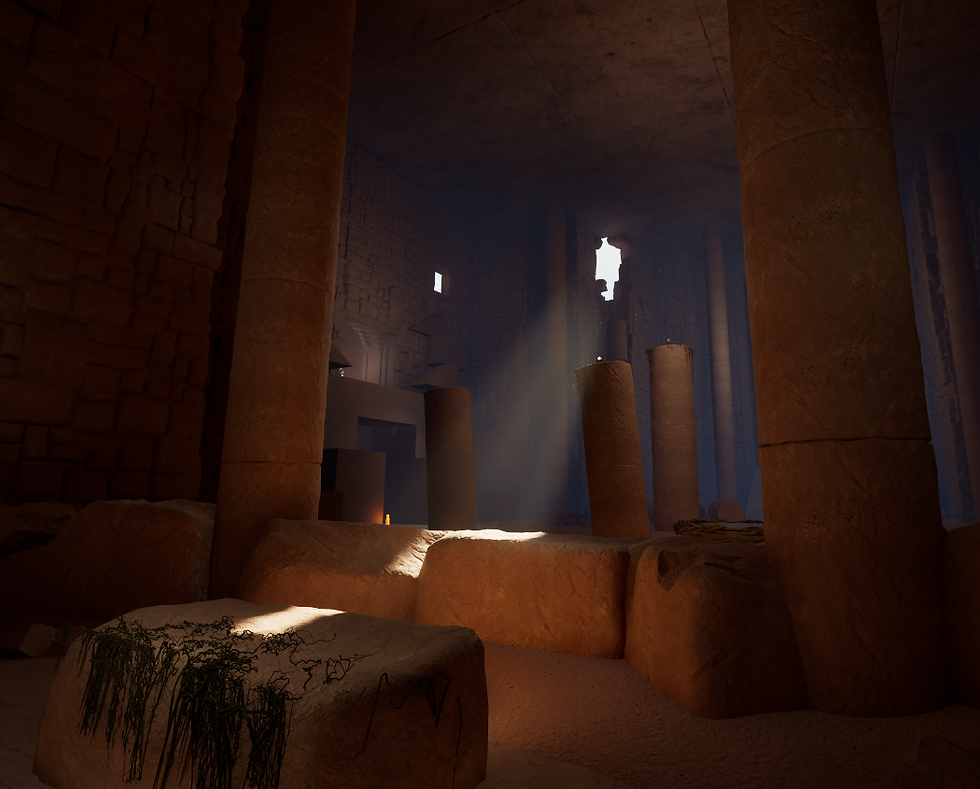
A Vertical Slice: Mapping Out the Introduction
We decided on making a vertical slice at the beginning of pre-production, so we narrowed our focus on making the beginning of the game and having the first level introduce all the mechanics and set the setting, tone, and mood for the rest of the would-be-game.
With this focus, I wanted to introduce the player to the different puzzle mechanics individually by incorporating a new mechanic in each section of the temple, with the last section testing the player's skill before reaching the end and finishing the level.

With this in mind, I created a total of 4 sections: The first introducing the player to the narrative and setting, the middle two introducing the player to the primary puzzle mechanics, and the last section serving as the final test of the player's skills before completing the level.
Mechanics: A Focus on Traversal Puzzles
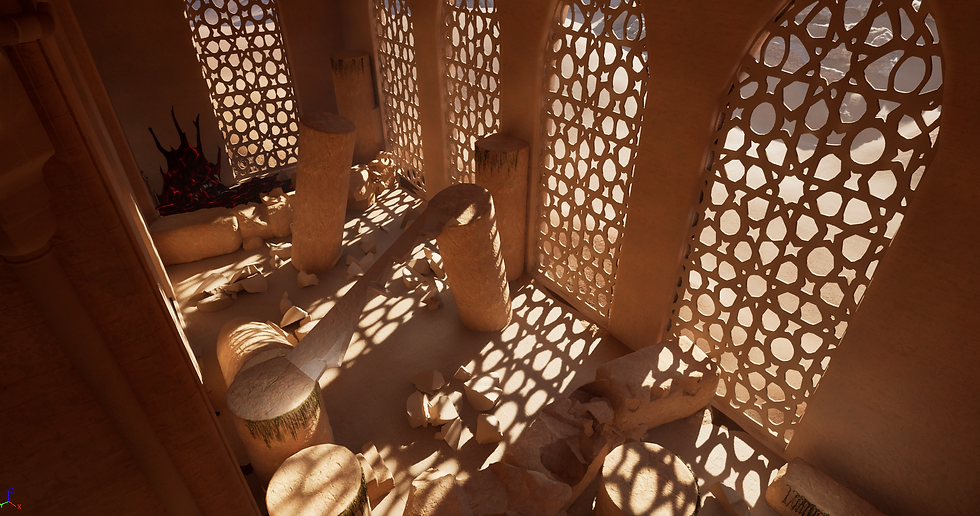
The environmental mechanics are introduced section by section. The mechanics are...
Jump pads that are activated for a short period of time and launch the player upward for a few seconds
Rotten enemies that chase the player when they enter their line of sight.
A distraction podium that can be activated to distract the enemies to a certain location.
For mechanics, we focused on environmental interactions and a core movement set. Throughout the level, players use basic movement to navigate the environment and use environmental mechanics to solve traversal puzzles. The player's movement and abilities consist of jumping, gliding, ledge grabbing, and the ability to push through rot for a brief amount of time.
The environment's main hazard is the rot itself, a corrupt force that damages the player on contact.
Level Breakdown
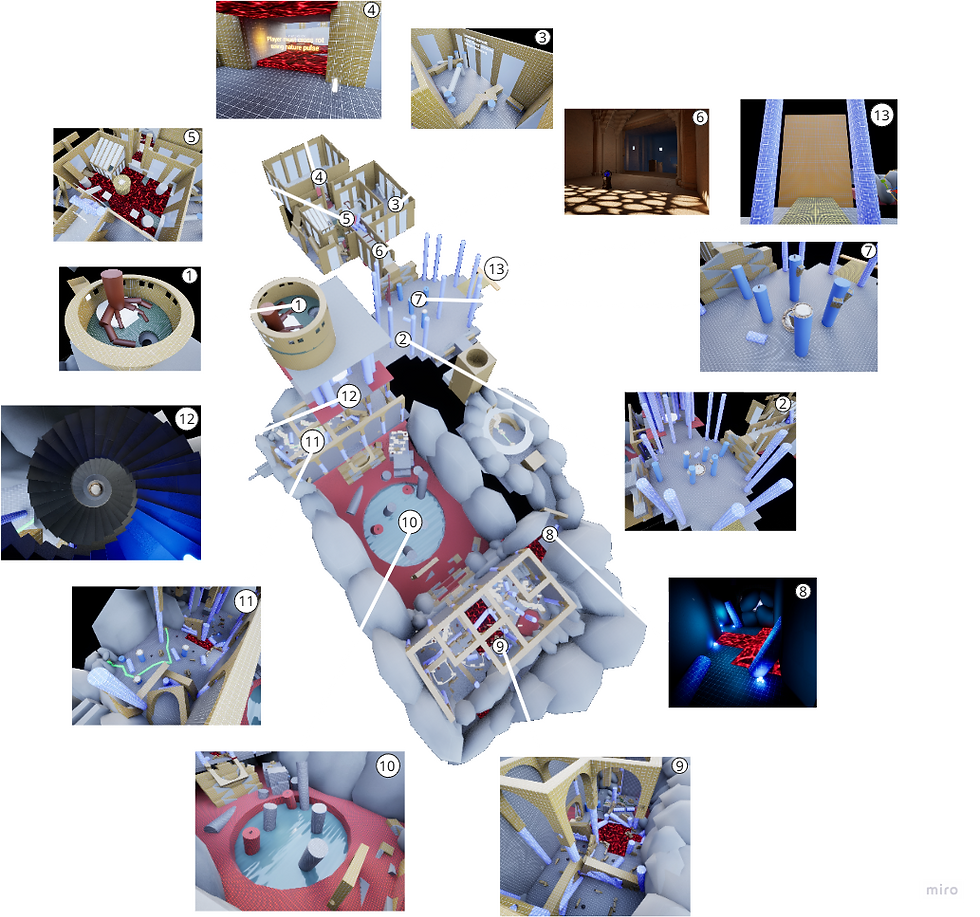
1. Cutscene/Navigation: The Godtree

A cutscene shows the player waking at the base of the Godtree, receiving the game’s premise and their power. Afterward, they descend a spiral staircase that triggers a top-down camera view. The music stops and the camera returns to normal once they leave the staircase.
1. Cutscene/Navigation: The Godtree

A cutscene shows the player waking at the base of the Godtree, receiving the game’s premise and their power. Afterward, they descend a spiral staircase that triggers a top-down camera view. The music stops and the camera returns to normal once they leave the staircase.
2. Exploration: The Main Temple

Player is dropped down into the main temple area which has two giant doors that are locked - showing the player's ultimate goal.
The player is given the freedom to explore, but is guided to their first objective in the first section.
3. Traversal: Garden Hallway
The player enters a hall where they must traverse through using their jump and glide.
This area also focuses on being brightly lit, showing off the beauty of the environment while making the player more familiar with the controls.
1. Cutscene/Navigation: The Godtree
A cutscene shows the player waking at the base of the Godtree, receiving the game’s premise and their power. Afterward, they descend a spiral staircase that triggers a top-down camera view. The music stops and the camera returns to normal once they leave the staircase.
4. Hazard Avoidance: Garden Room Part 1

Here the player is introduced to the pulse mechanic that allows the player to push back the rot and the jump pad mechanic that allows the player to be launched in the air.
The player also meets a spirit NPC that helps teach them this mechanic and gives some lore.
5. Puzzle/Hazard Avoidance: Garden Room

The player must find their way to the jump pad in the center of the garden room. They must traverse and navigate their way through the rot to activate the jump pad.
1. Cutscene/Navigation: The Godtree
A cutscene shows the player waking at the base of the Godtree, receiving the game’s premise and their power. Afterward, they descend a spiral staircase that triggers a top-down camera view. The music stops and the camera returns to normal once they leave the staircase.
6. Cutscene: End of Garden Room

When the player reaches the pedestal and activates it, a cutscene plays - focusing on the door and showing the first lock being unlocked.
7. Traversal: The Main Temple

After unlocking the first lock, the player ends up on a higher elevation and is able to platform across the broken pillars to the second section.
1. Cutscene/Navigation: The Godtree
A cutscene shows the player waking at the base of the Godtree, receiving the game’s premise and their power. Afterward, they descend a spiral staircase that triggers a top-down camera view. The music stops and the camera returns to normal once they leave the staircase.
8. Stealth/Traversal: The Cistern

When the player reaches the Underground Cistern, they are introduced to stealth and the distraction mechanic.
When the player gets past the first enemy, they must traverse and avoid the rot to navigate deeper into the Cistern.
9. Stealth: The Cistern

As the player gets deeper into the Cistern, they must navigate through the rot and avoid from being detected by enemies.
1. Cutscene/Navigation: The Godtree
A cutscene shows the player waking at the base of the Godtree, receiving the game’s premise and their power. Afterward, they descend a spiral staircase that triggers a top-down camera view. The music stops and the camera returns to normal once they leave the staircase.
10. Traversal/Stealth: The Cenote

After getting through the first half of the Cistern, the player will arrive at the Cenote, where they must platform and traverse across while avoiding detection of enemies.
11. Stealth/Traversal: The Cistern

After the player crosses the Cenote, they reach the final section - the second half of the Cistern.
Here the player is tested on all the mechanics they have learned within the level and must overcome this final challenge to complete the level.
1. Cutscene/Navigation: The Godtree
A cutscene shows the player waking at the base of the Godtree, receiving the game’s premise and their power. Afterward, they descend a spiral staircase that triggers a top-down camera view. The music stops and the camera returns to normal once they leave the staircase.
12. Cutscene/Traversal: Main Temple

Upon completion of the final section, the player reaches the last pedestal that unlocks the second lock on the door.
A cutscene will play showing the door being unlocked before the player can use the jump pad to descend back into the Main Temple area.
13. Cutscene: Main Temple

When they player gets back to the Main Temple, they will approach the unlocked door which will play a cutscene of the large door opening and the player exiting the temple.
Process Breakdown
Pre-Production
Ideation
During the ideation phase, we wanted to create a game that played to our strengths. We decided to go for more of a narrative approach, as our team was strong in narrative designers and art but our programmers weren't as familiar with Unreal Engine at the time.
So with this in mind, we idealized a narrative game with a focus on environmental puzzles and storytelling.
Key Influences we took during this stage of development included:
-
Legend of Zelda: Windwaker (Nintendo, 2002) for its puzzle solving and level structure
-
Prince of Persia (Ubisoft, 2008) for its environmental art
-
Lots of real life images of ruined temples and dry environments


System and Narrative Planning
When planning for the systems, I sat with the system designers Marcus Granlund, Aditya Dash, and Martin Jonson to look at the type of puzzles we wanted the player to solve. Since our primary focus was to make a narrative adventure, we didn't want the puzzles to be too complex. So we aimed to design environmental mechanics that the player must utilize with their movement to figure out how to navigate through a desolated temple filled with rot and ruins.
For the planning of the beats, sections, and flow of the game, I worked closely with our narrative designers Jerram Carr and Mimi Olsin. For the four sections made, we aimed to have each space convey a different tone and mood as a way to express the history of the world and foreshadow the future of what would become (the player cleansing the rot). We wanted to have the NPCs in different sections that represent the past, present, and future; so when it came to building the level, I worked closely with Jerram and Mimi to have these sections reflect that.


Level Design Document
Full Level Design Document can be seen Here
When creating the Level Design Document, I took a different approach in the formatting of the document. I use PowerPoint and consisted it of primarily visuals to be more straight to the point and better convey the vision and work that I was performing.
Within my LDD I define these areas:
-
Player Experience Overview
-
References
-
Level Layout and Structure


Level Beats
Working on the beats, the narrative designers and I wanted to create a balance between moments of calm where its the player and the environment and moments of high tension where the player might be caught by an enemy or focused on a traversal puzzle. By maintaining this balance, we hoped to achieve a dynamic experience with both valleys and peaks of tension.
During the creation of the level beats, I purposefully designed each beat to be changeable, rearranged, or be removed entirely to help with potential budget cuts or issues that may arise in the future, which did end up happening due to scope creep and running out of time.
Beats 11-15 ended up being shortened with beats 12 and 14 being cut entirely. Beat 11 was rearranged to coming after 13, and the rest stayed the same. Due to these cuts, the entire outdoor section (which can be seen here in the 2D map) and the bridge were removed and were combined with the end of Section 2.
2D Map
During the 2D map phase, I looked to Legend of Zelda: Windwaker (Nintendo, 2002) dungeons to gain a better understanding of the flow and pacing of the puzzles. Since our setting took place within a temple and our focus was on narrative and environmental assets, I envisioned the temple to be grand - but this vision also ended in scope creep, and the overall scale of the temple ended up being too large in the long run.
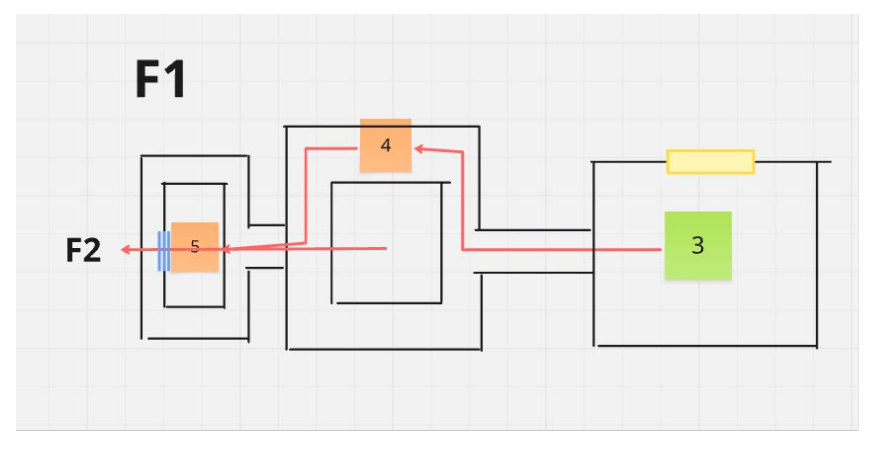
With the narrative designers, we initially planned for 5 sections. The first being the Godtree room, then the main temple area itself, the gardens where the focus will be around the present, the cellar storage room with the focus on the past, and then the outdoor area where the focus would be the future. But later in development, the decision to cut the final area that was to take place outdoors was cut, and was combined with the cellar storage area.



Blockout and Iterations
Laying the Groundwork
At the beginning of my process, I first made a flat blockout that outlined and defined the different sections and rooms I planned to build from my 2D map. I laid the groundwork out to get a feel for scale and the level flow.
However, while I did lay the groundwork to get a feel for scale, we failed to define the measurements we wanted to use for the game and scale of the temple, which resulted in the level to be a bit too large in scale. Since we wanted to make a temple, I envisioned the level to be a bit large to reflect the grand scale of a temple, but this ended up causing scope creep later down the line because of the sheer size of the temple.


The Godtree Room
The Godtree Room served as a vital piece to the narrative, as it established the story’s premise and the death of a god before sending the player on their quest to cleanse the rot from the temple.
From the start, I knew we wanted this moment to special for the player. So to reflect the importance of this beat, I worked with the artists to make this a hero piece, and make it a small space that only the player and the Godtree will occupy. Shortly after this scene, I envisioned the player descending down into the temple, leaving the last bastion of hope before entering a desecrated and ruined temple. For this descent, I wanted it to be an important moment to highlight this experience to the player, and worked with the system designers to make a camera change - switching it to top down - as the player walks down the spiral staircase and then having the music cut when the staircase cuts off.
The blockout was simple with not much change made throughout development. It was an important piece we wanted to keep in and establish from the start.


The Main Temple
The Main Temple area went through several changes during blockout. There were two goals I needed to balance for this area.
First, I wanted to capture the temple’s grandness and history: a once-cherished place that is now dying and in ruin.
Second, I needed to guide the player clearly through each section without excessive backtracking. Since this area functioned as a sort of “hub,” each completed section would have the player return to this area, unlock part of the large door and open the next path, which made clear navigation essential.
However, in pursuing these goals, I overscoped and expanded the space far beyond the initial layout. I wanted the player to take in the temple’s scale, feel immersed, and have more room for traversal into the second section after completing the first; but this upscaling ultimately added more work for the art team.


The Garden Room
For the Garden Room, I set two core goals. The first was to introduce two mechanics: the player’s ability to push back the rot and the use of timed jump pads. The second was to emphasize the beauty of the ruins, with the gardens being brightly lit. Narratively, we wanted the Garden Room to represent the world’s past when it was bright and full of hope, so I wanted to design the space with a lighter tone that highlights the temple’s beauty despite its decay.
The blockout itself went through a few changes overall. The most significant adjustment was expanding the room to include a hallway that builds up to the central garden. The purpose of this expansion was to give the player space to become comfortable with their movement set and learn the new mechanics before entering the central garden area where these lessons are reinforced.
The Cistern
The Cistern went through the most iteration out of the entire blockout. Initially, the level was divided into three sections outside of the main temple: the Garden Room, the Cistern, and a Bridge/Outdoor area. Due to overscoping and time constraints, the Outdoor Area was ultimately cut and merged with the Cistern.
The Outdoor Area was originally meant to serve as a final test of the mechanics introduced in earlier sections, acting as the level’s climax. However, in pursuit of this vision by combining both spaces, I ran into scope creep and expanded the Cistern far beyond what was necessary.
I struggled significantly with scale while building the Cistern, particularly overestimating how much space was needed for stealth. In attempting to reconnect the Cistern to the Main Temple, the area became overly large, which led to compromises in narrative and environmental storytelling. Structural questions like the purpose of the large cenote or the mechanism that opens the floor back to the main temple were left unanswered due to time constraints and should have been explored more deeply with the team.


Reflection
Pre-Production Challenges
Pre-Production was very rushed from the start. While we had seven weeks to work on this project and had a tight timeline, there was a lot of miscommunication on responsibilities and goals.
One of the producers and I struggled at the start with understanding the artists vs level designer responsibilities. The producer wanted me to make a blockout on day one before proper research and a LDD and 2D map could be made while I, on the other hand, didn't understand exactly what the environmental artist needed to start their work during pre-production. So in light of this, I took the time to reach out to my mentor and other professionals in the industry to ask questions about the relationship between an artist and a level designer. Understanding this, the producer and I came to an understanding of the process between artist and level designer's role and responsibilities.
With that said, because of our tight timeline, a lot of these responsibilities were rushed regardless and many processes and tasks were performed at the same time to keep up with the deadline. Examples of this include the narrative, art asset lists, and blockout being created simultaneously.
Level Design and Scope Creep
Throughout the project, I really struggled with scope creep and scaling down my level. While I had purposefully designed the level beats to be changed, rearranged, or removed in case of scope, I still had a tendency to overscale the sections during the blockout process. I had a lot of difficulty understanding the scale of the level and focused too much on the vision of having a large, grand temple. A big mistake I made was not utilizing measurements during my blockout to better understand the scale between the player and the environment.
In the long-run, this caused issues with the artists in having enough people to set-dress the level and making sure we had all the assets needed. While I made this mistake, I learned more about the artist's process and the importance of scale. It has made me a lot more conscious about using measurements during blockout and thinking of the level art and its implementation into the level. I learned a lot on how to better communicate with artists about assets and art implementation.