Level Designer

Ultimately this project was a major challenge in team vision alignment and understanding how to work with people in the same discipline. The level for the village ruins overall is a bit rough, it has poor guidance, the order of puzzles to complete is confusing, and the overall objective for the player isn't clear. While the level itself is rough around the edges, a lot of lessons were learned which makes it one of the projects I am proud of.
If you wish to jump to the reflection of the project, click here to skip to the full reflection on the challenges that I came across and what I learned going forward.
Introduction
Shattered Veil is an action-adventure FPS game taking place in a dark Celtic fantasy world. Possessing the power of the Seeing Stone and your ritual dagger, uncover all the secrets in the environment and seal away invading forces from another world.
Made by a team of 20 people, I had to face the challenge of being both a product owner and level designer.
Shattered Veil: Village Ruins
Genre: 3D Puzzle Action Adventure
Type: Finished Product
Engine: Unity 6
Tools: Probuilder, Perforce
Development Timeline: 5 Weeks
Team: 20 People
Role: Product Owner and Level Designer
Fast Travel
Level Overview
Summary
The forest has been corrupted by the Fae of the Otherworld and it is up to the player - an acolyte of a religious order against the Fae - to find the Ritual Dagger, an ancient blade that contains voices of heroes from the past.
The player must find the relics from this land's history to perform the Rite of Cleansing to rid the corruption and save the land.

Core Mechanic: Playing with Perspective
-
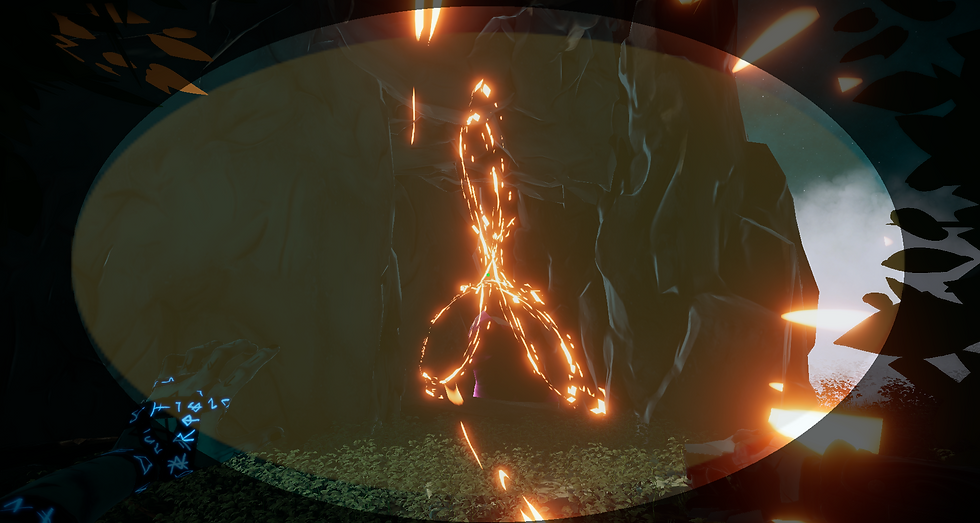
For this level, I wanted to utilize the core mechanic, the Seeing Stone, an ability that grants the player to see invisible objects, to solve puzzles and navigate through the level.
-
I structure visual cues to highlight areas where the Seeing Stone can be used. That way the player knows when to use the ability.
Puzzles: Finding the Solution
-
I aimed to have the player explore to discover environmental puzzles while using the Seeing Stone to see the difference between reality and illusion to solve them.
-
When designing the puzzles, I wanted to focus on simple mechanics between the Seeing Stone ability to keep within scope of the project - so we decided to focus on lock and key mechanics:
-
The player must find a keystone and slot it into its corresponding pedestal to unlock paths/doors.
-

Combat: Pushing Past the Corruption

-
We wanted to integrate a mix of combat and puzzle solving for the core loop. We focused on only ranged combat for the player that would be evenly paced out through the level.
-
For this level, I inserted two combat encounters with each serving a specific purpose -
-
The first to Introduce Combat
-
The second to serve as the climax for the level before the player completes the level's overall objective.
-
Level Breakdown

1. The Ritual Room - Obtaining the Ritual Dagger
The player’s first objective is to obtain the Ritual Dagger. Upon entering the village, they discover the Ritual Room locked. A nearby hut with the key inside is marked with the same symbol as the Ritual Room hut, indicating a connection between those two huts.
Returning to the Ritual Room, the player unlocks the door and claims the Ritual Dagger. Upon pickup, a voice line plays—introducing the narrative of the weapon’s former owner, who now speaks to the player through the blade.

2. Combat Clearing
Upon exiting the hut, the player encounters their first combat scenario as enemies emerge from the surrounding fog. The Ritual Dagger’s voice instructs the player to throw the weapon, introducing the core combat mechanic. The clearing is enclosed by a dense fog, preventing escape until all enemies are defeated.
3. First Hut Keystone

After the combat encounter, the player discovers a locked hut behind the Ritual Room, sitting between two empty pedestals. Their next objective is to locate the two keystones needed to unlock the hut. A key placed near the left pedestal subtly guides the player to hint that it opens the door leading to the first keystone, found in a locked hut to the left of the Ritual Room.
4. Second Hut Keystone
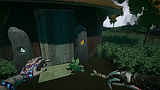
The second keystone is located directly south of the pedestals, inside a hut with a blocked entrance. A symbol is visible on the roof, and a matching glowing symbol can be found behind the hut, prompting the player to use the Seeing Stone. Activating the Seeing Stone reveals a hidden opening at the back, allowing the player to enter and retrieve the second keystone needed to unlock the hut behind the Ritual Room.
5. First Gate Keystone

Once both keystones are placed into their respective pedestals, the hut behind the Ritual Room unlocks and opens, revealing a statue inside holding a third keystone. This keystone is required to open the gate leading to the Relic Room. The player retrieves it and slots it into the first of two pedestals positioned just outside the hut.
6. Cave Keystone

To obtain the second gate keystone, the player must unlock the door leading to the arena. The pedestal keystone required for this door is located within a cave west of the village entrance. By using the Seeing Stone, the player reveals a hidden entrance and navigates through the cave to retrieve the keystone, which is then used to unlock access to the arena area.
7. Combat: Second Gate Keystone

Upon entering the arena, the gate keystone can be seen lied at its center. As the player approaches, combat is triggered, and the arena’s edges become sealed, preventing escape. The player must defeat all enemies before the barriers lift, allowing them to collect the keystone and return to the gate to progress.
8. Relic Room

With the final keystone placed, the Relic Crypt opens. Inside awaits the relic, and once it is claimed, the dense fog that once shrouded the area dissipates, signalling the player’s progression forward.
Reflection
Team Misalignment
During the project, one of the level designers and I struggled to align creatively and communicate effectively. As Product Owner, my role was to uphold and communicate the project’s vision and step in when disagreements arose—but I failed to ensure that vision was clearly shared across the team. I understood what I wanted, but I didn’t articulate it well enough for others to follow, which led to misalignment that only became clear late in production.
My biggest mistake was assuming everyone understood the vision rather than confirming it through regular check-ins. By the final week, we took a step back, redefined the vision together, and moved forward with a unified direction.
From a level design perspective, I also made structural mistakes. Early on, I worked with the narrative designer to align story and level beats, but collaboration with the other level designer lacked clarity. I created a blockout that unintentionally redefined the layout, forcing major rework. When the other level designer confronted me about this, I realized my mistake and made the decision to scrap the level entirely and start from the beginning; this time aligning with the existing landscape and maintaining consistent communication. However, resolving these issues came late in development which left little time for playtesting and pushing the design of the puzzles and iteration to the final stages.
Level Design
The Seeing Stone mechanic ultimately failed to achieve its intended purpose. My goal was for players to use it intuitively to solve puzzles, but in practice, the ability only revealed information rather than offering different perspectives. As a result, most players simply activated the Seeing Stone and kept it on for the entire level, removing any intended layer of interactivity or discovery.
Looking back, I should have designed the Seeing Stone to reveal alternate information or realities, encouraging players to switch between the two states—worlds seen with and without the stone. This would have provided a stronger sense of discovery, supported environmental storytelling, and made puzzle-solving more engaging and dynamic.
Ultimately, this project became a valuable learning experience. Despite its shortcomings, it helped me identify critical design lessons. I later chose to rebuild and refine the level in Unreal Engine, both to deepen my technical skills and to explore how the Seeing Stone mechanic could better support player curiosity and exploration.